

ALPACAS - A Getting Started Guide
A Comprehensive Introduction to the World of Alpacas
Section 3 -
Fiber Structure
Basic Fiber Anatomy and Physiology
In order to make informed decisions on selecting quality foundation herd animals with desirable fiber characteristics, the new alpaca breeder must understand basic fiber anatomy and physiology. This section provides information that will help you understand the differences between suri and huacaya fiber what makes a good fiber producing alpaca.
Alpaca fiber is composed of three distinct elements; the cuticle or scale, the cortical cells and an intracellular binder to hold it all together. A complex protein called keratin forms the composition of the fiber. The fiber itself is a complex assembly made up of a vast number of cells. The inside of the fiber consists entirely of rounded elongated and spindle shaped cells called cortical cells. Cortical cells are thick in the middle and taper away to a point at each end. The outer cells (cuticle) are hard flattened scale-like cells which do not fit evenly together. The edges, of these cells protrude from the fiber shaft giving the fiber a serrated edge.
Cortical cells are the load-bearing elements of the fiber, whereas the cuticle imparts the inherent aesthetic qualities of the fiber such as softness of handle and luster. Other functions of the cuticle include water repellence, felting during washing, and resistance to chemical and physical attack. The entire assembly of cells is held together by a type of ‘cement’ called the intracellular binder.

Research has shown that the cuticle cells on sheep wool fiber protrude approximately 0.8 micron from the shaft whereas alpaca cuticle cells protrude approximately 0.4 micron. It would therefore be simple to conclude that the softness of alpaca over that of sheep wool of the same fiber diameter is due to the scale height (protrusion)[i].

Differences between Suri and Huacaya Fiber
The first difference between huacaya and suri fiber is that cuticle cells of the Huacaya protrude slightly more than the Suri, Having less scale frequency and a lower cuticle height, the Suri fiber feels more slippery and is more lustrous than huacaya fiber.
.png)
The second difference between Huacaya and Suri fiber is in the internal composition of the fiber. The Huacaya has a bilateral structure similar to sheep and the Suri does not. Bilateral structure refers to the presence of the two types of cortical cells which are classified as either orthocortical cells or paracorticle cells. These cells grow in bundles next to each other. The bilateral formation is responsible for the crimp/crinkle in the Huacaya. The orthocortex bundling is always found on the outside of the crimp curve. As the two cortical cell types grow alongside of each other the orthocortex provides the tension that forms the curve of the crimp while the paracortex, under less tension, causes the crimp to stay in place. There is no visible line of distinction between the two cortical cell types in the suri fiber and thus the suri fiber is characterized by relatively straight fibers rather than crimp.
Because of different fiber structures, huacaya and suri require variations in processing techniques. Suri is generally more difficult to process. The machines are set at a lower speed than for the huacaya. Due to its cuticle cell structure and straightness Suri fiber lacks cohesion making it more difficult to ‘spin’ and there is slightly more fiber wastage when processing. Also, because of the straightness of the Suri fiber compared to the crinkle in the Huacaya, more fibers are required in a Suri yarn than that of a huacaya. This gives suri fiber more bulk and a heavier weight.
Follicle and Fiber Types
Follicles are the skin structures from which the fiber grows. Alpacas have two distinct follicle types: the primary follicles and the secondary follicles. Primary follicles are the first follicles to develop in the fetus during the first three months after conception and are the focal point around which secondary follicles form at a later stage. Primary follicles produce fibers that are greater in diameter and have little or no crimp in the staple and no crinkle in the individual fiber. These are the relic of guard hairs that are seen in primitive types of alpacas as long, straight hairs that project beyond the length of the finer and softer down underneath.
.png)
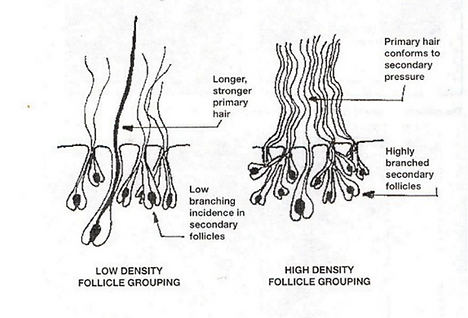
Secondary follicles produce the undercoat or down of the fleece and are the softer, finer fibers that give alpaca fiber its luxury feel and improved insulation qualities. The secondary follicles develop around the primary follicles after the fourth month to create follicle groups. A higher ratio of secondary follicles to primary follicles creates finer, softer and more uniform fleeces. In huacayas, the secondary fibers create the crimp which is exhibited as waves within the staple or lock.
A subtype of the secondary follicle is called a derived secondary follicle. Fibers from derived secondary follicles exit the skin from the secondary follicles they are grouped around. They have their own follicle root and enter the follicle sheath from the side and share a common exit point from the skin. These fibers are the finest the alpaca produces and form a higher percentage in the fleece of elite alpacas. The noticeable fineness may be due to the increase pressure of several of these fibers exiting the same skin opening. This causes the fibers to not only squeeze through by becoming finer but also longer because of the squeezing action. Needless to say, these are highly desirable fibers.
A third type of fiber is called medulated fiber. Medulated fibers are course fibers that cover a range of types including solid, hollow and various grades between the two extremes. They create problems for the fiber processors in that they do not accept dye readily or uniformly thus producing variations within the yarn that make it largely unacceptable for premium markets. They present customer acceptance problems for processors because they have sharp ends which protrude from the finished product and create a prickle factor when felt against the skin. In the early days of alpaca development in the U.S., much was made of the supposed superior insulation properties of this miracle fiber with its hollow core. Alpaca fiber was touted as having 5, 8 or even 10 times the insulating qualities of even the finest wool. This claim is without foundation and has been debunked for some years now but it is occasionally aired with conviction.
The Correlation between Density and Fineness
Density is defined as the number of follicles per unit area of skin. Density is a highly desirable trait not only because dense animals produce heavier fleeces, but their fiber will most likely be finer as well.
As fleece density increases the primary fiber diameter decreases due to the pressure of secondary follicles forces the primary to conform to the group average as they from tight, individual bundles of closely aligned fibers. Because of these closely aligned fibers, you can visually identify a dense fleece by the ability to clearly see all the way to the skin of the alpaca when parting the fleece. In fleeces that are not dense, the primary fibers may be as thick as 30 to 40 microns in a young animal and there will be more crossing and intertwining of fibers making it more difficult to see the skin.
Some alpaca breeders report an increase in fiber density after the first shearing. A possible explanation of this is that even though the derived secondary follicles are normally in place by birthing, the appearance of the fiber from these follicles may take some time after birth to become apparent. Shearing may stimulate the growth of fiber from the derived secondary follicles[ii].
Fiber Criteria
Alpaca fiber is all about sensation; the sensation of touch as reflected in smoothness, softness, evenness and, in the case of suri, slipperiness and visually by brightness (luster in suri), crimp and color. Objective measurement should never be the sole arbitrator in the decision making process but it should always be an essential tool in the decision making tool kit. Objective measurement not only allows independent comparison between animals, but also provides a benchmark for evaluating future progress. Defined below are objective fiber evaluation terms that every alpaca owner should be familiar with. An understanding of these descriptors will prove helpful when evaluating the fiber characteristics of an alpaca you are about to buy.
The Histogram
The histogram is a graphic representation of the distribution of the mechanical measurement of an alpaca fiber. The histogram displays the distribution of the number of sample fibers according to the fiber diameter (micron count) and the statistical frequency within that micron count. Plotted on a standard graph base with the number of fibers along the left axis and the micron count along the base axis, the evaluator can immediately gain a distinct interpretation of the fleece sample from the graphic representation.
.png)
Staple Length
Staple length is arguably the single most important consideration given by buyers when accessing fleece for purchase or processing. Staple length is affected by crimp definition, by nutrition and environmental influences, and genetically. Broad, bold crimp is generally associated with longer staple length with the ultimate expression being suri, which has no crimp. Staple length can be affected by environmental factors including weather but is most affected by age and reproductive activity. Older animals progressively have shorter staple lengths. Pregnant and lactating dams also produce shorter fleeces.
Micron Count
A micron is 1 millionth of a meter or 1 hundredth of a millimeter – by any means, a very small measurement! To gain perspective, the average human hair measures 60 microns in diameter. It has already been noted that fibers with a diameter exceeding 30 microns cause a prickle sensation when worn next to the skin. It follows then that very fine fiber does not prickle and can be worn against the skin comfortably. Fineness also translates into softness and lightness when processed into a product.
Alpaca fleece is graded into various categories, based on the micron count. The criteria for these can vary somewhat between processors, but this following list is a good guideline:
-
Royal <20 microns
-
Baby 21 - 23 microns
-
Standard 24 - 28 microns
-
Adult 29 - 32 microns
-
Coarse 33 - 35 microns
-
Very Coarse > 35 microns
There is a trade-off between the fineness of the fiber and the weight of the blanket. In many cases, particularly at the very finest level, the premium paid for the fine micron count is not sufficient to make up for the loss of weight.
Standard Deviation
Standard deviation is a calculation designed to indicate how consistent the micron count is distributed throughout the sample being tested. Put simply, a standard deviation describes where 68% of the fibers lie in relation to the mean fiber diameter of the sample. The mean fiber diameter is the value where half the fibers have a smaller diameter and half the fibers have a larger diameter. Standard Deviation (S.D.) is measured and quoted in microns. So, a standard deviation of 4.0 microns means that 68% of the fibers from the sample fall within the 4.0 micron range. Breeding goals should include decreasing the S.D. of the herd because the lower the S.D. the more consistent the fiber diameter.
Co-efficient of Variation
Co-efficient of variation (C.V.) is a calculation expressed as a % which is designed to give an alternative method of describing evenness of micron in a sample. It also allows comparisons between samples that are more accurate and reliable than standard deviation alone. For example, an S.D. of 3.5 on a 30 micron fiber sample is a much better reflection of consistency than an S.D. on a 15 micron sample where the S.D. represents a much larger proportion of the mean. C.V. allows a breeder to look at like animals and compare them within a herd under the same management and environmental conditions. Exceptional finer fleeces with reflect low C.V. with values under 20% being highly desirable and reflective of superior fleece.
Comfort Factor
Generally speaking, fibers with a diameter greater than 30 microns create a prickle sensation when worn against the skin. The value of the comfort factor is determined by subtracting the percentage of fibers with a diameter greater than 30 microns from 100%. For example, if the percentage of fibers greater than 30 microns is 3%, then the comfort factor is 100% - 3% or 97%
Breeding Goals
Each breeder should have specific fiber characteristics that they are trying to achieve. These can be described in a herd breeding plan. An example is given below.
In their herd breeding plan, farm XYZ has created fiber criteria of as indicated in the table below. These are the standards the have set to measure the success of their breeding program. In order to achieve these standards, they will cull from the breeding program any animal that does not meet them.
Fiber Criteria | Measurement |
|---|---|
Comfort Factor | >97% |
Co-efficient of Variation (CV) | <20 |
Standard Deviation (SD) | <4.0 |
AFD Adults over 5 yrs. | <28 micron |
AFD Adults | 18-25 micron |
AFD Yearling | 16-22 micron |
Staple Length | 6+ inches |
Shear Weight | 8 lbs. or more at 2 years (5.5 lbs. of which is blanket) |
In this illustration, AFD refers to Average Fiber Diameter – the thickness of individual fibers. Anything under 25 microns (µ) is regarded as good. Whatever figures you decide upon, they should only be used as a guide. Many different factors can influence the figures, including age, diet, environmental conditions, health, and pregnancy. Again, the farmers to whom you are talking should be able to explain this to you. Words of caution however, beware of anyone saying that these figures are unimportant, and that it is only “hand” (the way the fleece feels) that matters. While hand is important, particularly in the show ring, the measured figures are the only definitive, accurate basis for comparison. Just be sure to compare like with like.
Understanding alpaca fiber is essential for making sound breeding and herd improvement decisions. Alpaca fleece is composed of keratin-based fibers structured with cortical cells for strength and cuticle cells that influence softness, luster, and processing qualities. While both Huacaya and Suri alpacas produce luxurious fiber, their structural differences affect appearance, processing, and market use—Huacayas producing crimpy, lofty fiber and Suris yielding silky, lustrous locks. Fiber quality is also influenced by follicle types, density, and the presence (or absence) of coarse medulated fibers. Objective measures such as micron count, standard deviation, comfort factor, and fiber density provide breeders with reliable tools to compare animals and set realistic herd goals. By combining science-based evaluation with hands-on observation, breeders can select foundation animals that will advance both fiber quality and long-term profitability.
[i] “The Spin on Suris and How they Differ from Huacayas”, Cameron Holt, International School of Fibres, Pambula Beach, NSW Australia
[ii] “Alpaca Fibre – An Introduction”, Ian Watt, Alpaca Consulting Services of Australia, Norwood, South Australia
© 2025 Heritage Farm Alpacas & Events, LLC. All rights reserved.
No part of this publication may be reproduced, stored in a retrieval system, or transmitted in any form or by any means—electronic, mechanical, photocopying, recording, or otherwise—without the prior written permission of the publisher.
For permissions, inquiries, or additional information:
Heritage Farm Alpacas & Events, LLC
4073 N 1200 W, Flora, IN 46929
Phone: (765) 412-0185
Email: info@ourheritagefarm.com
Website: www.ourheritagefarm.com